
Search result vs. claim form
Why does a Texas property show $0?
A $0 result can still have shares. The search amount may describe the cash shown for that property, while the emailed claim form gives you the share count.
Next: another reported name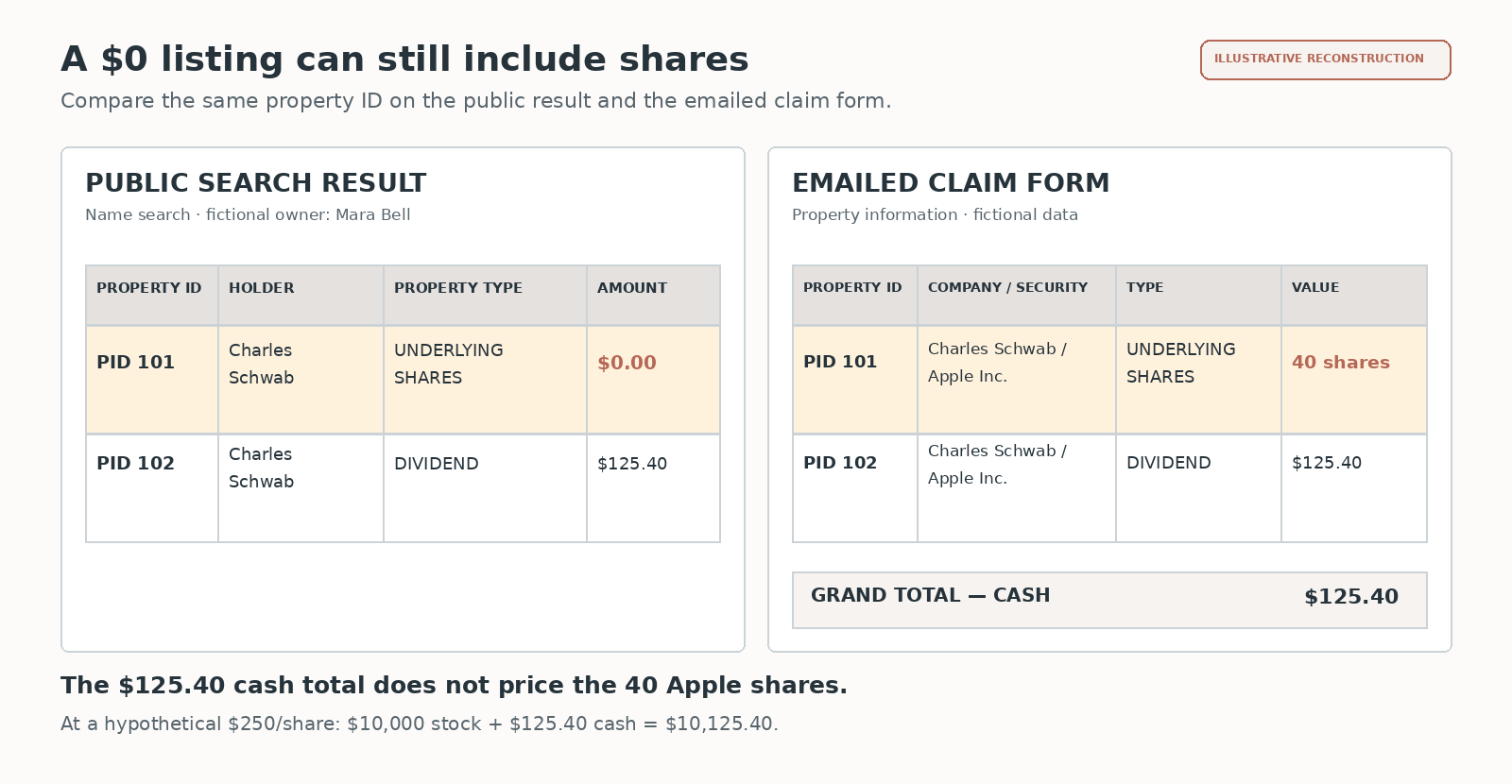
From $0 to the real value
In this fictional example, the public search shows $0 for PID 101. The claim form shows 40 shares of Apple stock under that same property ID. A separate dividend under PID 102 adds $125.40 cash.
The claim form’s Grand Total — Cash of $125.40 accounts for the dividend in this example; it does not price the stock. The potential value can be much more significant than the first search result suggests.
Cash displayed for stock property PID 101.
The form reveals the share count under PID 101.
Cash from the separate PID 102 dividend; shares are not priced.
At a hypothetical $250 per share: 40 × $250 = $10,000 in stock, plus $125.40 cash. The real value depends on the share price and what is actually paid.
Sometimes the listing hides even more
If the search result says “Not disclosed” for the holder or property type, you may not know whether it involves stock or another type of property. For the first two years after the holder reports the property to Texas, those details can be hidden from the public search. The emailed claim form can reveal additional information, including shares that the search did not identify. See Texas Property Code § 74.104.
Lastly, if stock and cash are reported under the same property ID, the public search can display the cash portion instead of $0 while still omitting the shares’ market value. I compare property IDs, share counts, and cash separately before I estimate anything.
What I would check next
- Save each property ID from the search result.
- Compare those IDs with the claim form when it arrives.
- Record the security, share count, and associated cash separately.
- Check a current share price before estimating value; it changes over time.